Two bells have the same natural frequency and are struck so that each initially stores the same mechanical energy . One has quality factor ; the other, . After the blows, no further energy is supplied. How much energy remains in each bell after ten natural periods? When the low- bell has fallen to one percent of , how much remains in the high- bell — and what fraction of its original amplitude does each bell still have?
Solution
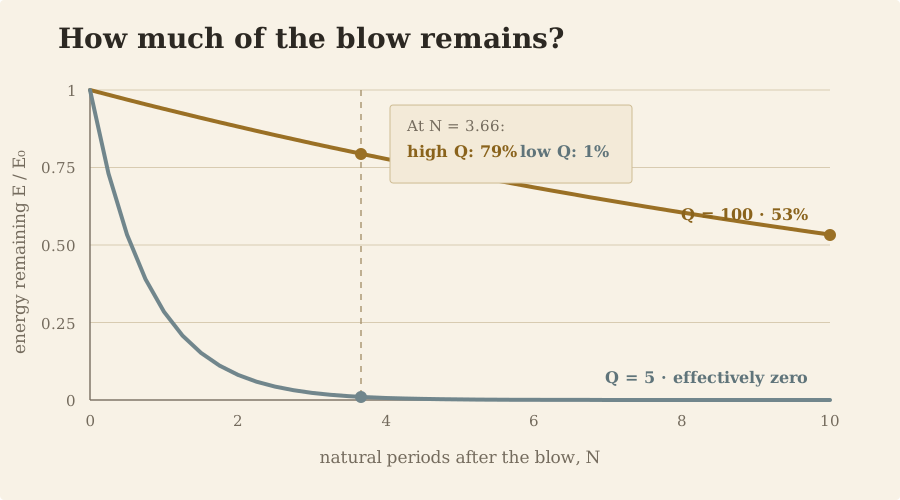
After ten natural periods the bell still holds about of its energy; the bell holds only of its energy and is effectively still. When the low- bell reaches , the high- bell retains about . Their amplitudes are then and of their initial values.
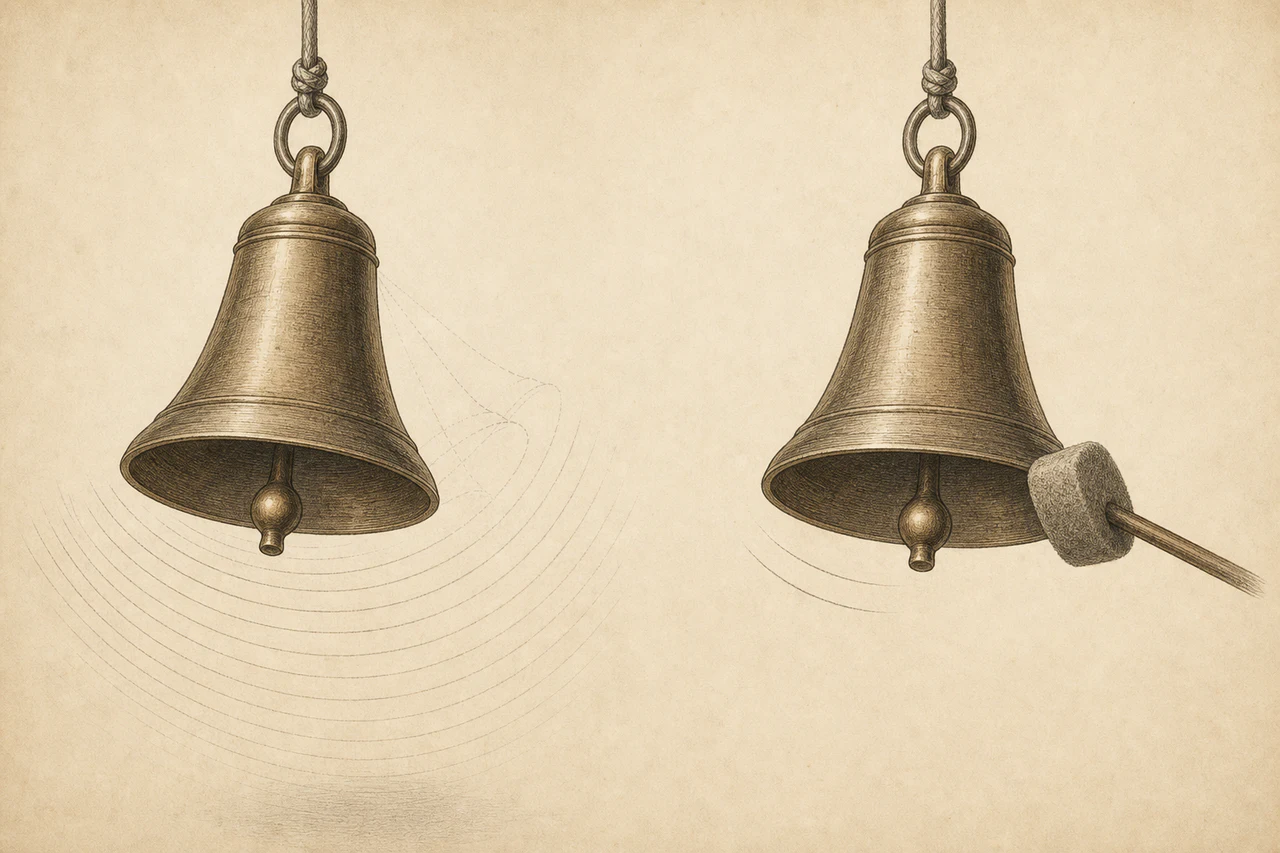
Figure 1. The bells begin alike; only their dissipation differs. The high- bell remembers a blow for many cycles, while the felt damper gives the low- bell a short memory.
For a lightly damped oscillator, the definition of quality factor gives the cycle-averaged power loss as
Once the blow is over, that loss is the whole energy balance:
Here means the energy averaged over a cycle — and for linear damping the envelope obeys this equation exactly, which is why the result can be trusted even at , where the nominal loss per cycle, , exceeds unity and any naive per-cycle bookkeeping visibly fails. What light damping actually buys is only the identification of the ringing rate with : the damped frequency is lower by — half a percent at , nothing at all at .
Count time in natural periods, . The energy envelope then becomes
Ten periods later
Substitution at gives
The high- bell has lost not quite half the blow. The low- bell has less than four millionths of it left: at the same cycle count, the former carries roughly times as much energy as the latter.
Catch them at the same instant
Let the low- bell fall to . Its cycle count is
At that very instant the high- bell retains
Figure 2. Equal pitch makes cycle count a common clock. The two energy envelopes separate almost immediately.
Energy is quadratic in amplitude, . Thus at this snapshot
One bell has only a tenth of its original swing while the other still swings at nearly nine-tenths. Energy decays twice as fast in the exponent because it is the square of the amplitude.
A caution about clocks. Quality factor measures memory in cycles, not directly in seconds. The energy e-folding time is
The subscript matters: this is the energy e-folding time, and the amplitude, being its square root, e-folds only after twice as long, — the same factor of two the snapshot above just exhibited. (Quoted in cycles: energy e-folds in periods, amplitude in .) If the frequencies differ, a high- resonator can therefore die sooner by the clock. A resonator at has , whereas a oscillator at has . High means long memory per cycle; the frequency decides how quickly the cycles pass.
Deeper in the notebook: the Classical Mechanics shelf — still being bound; damped motion and resonance will live there.