A sedan steers its front wheels; a forklift steers its rear wheels. Give both the same wheelbase, the same maximum steering angle, and both gears, forward and reverse. Is there any path one can trace that the other cannot? And as each begins a left turn while rolling forward, which way does each body first swing?
Solution
In the reachability sense, no: both machines can reach exactly the same poses — in the open plane either gear alone already suffices, and reverse is what lets them do it inside a tight corridor. But they do not sweep the same area during a given forward turn. A sedan beginning a left turn sends its nose left; a rear-steered forklift points its rear wheels right and sends its tail right.
1. Put the turning center on the unsteered axle
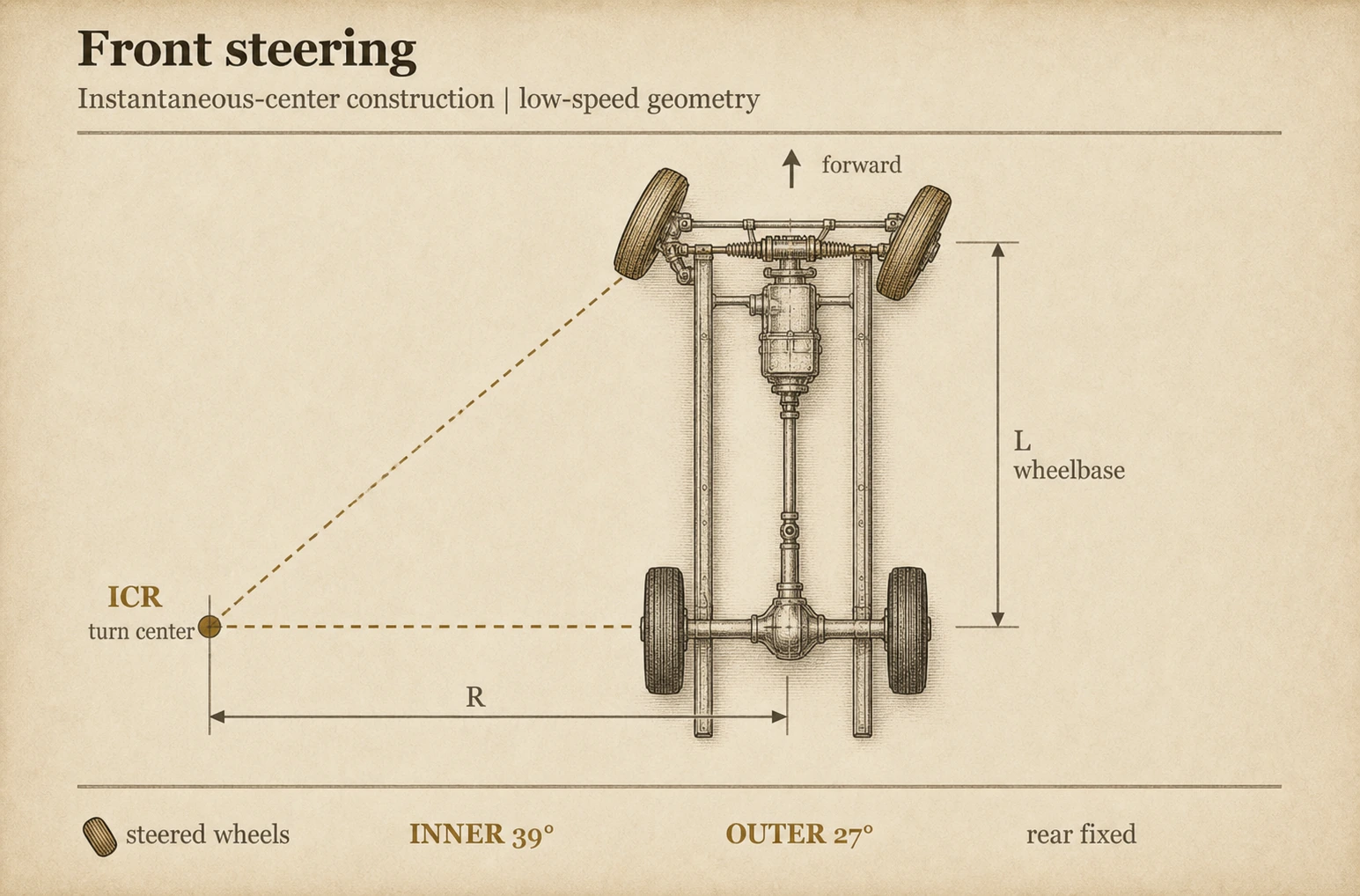
At low speed, treat each axle as one wheel at its midpoint and assume rolling without sideways slip. The vehicle’s instantaneous center of rotation (ICR) is where the lines perpendicular to the wheel headings meet. Because the unsteered wheels point along the body, the ICR must lie on the line of the unsteered axle.
Figure 1. Front-steering chassis: the ICR lies on the fixed rear-axle line. The cutaway exposes the steering rack and tie rods at the front, with the gearbox, driveshaft, and rear differential aligned along the frame.
For the sedan, the rear axle is unsteered. Its midpoint follows the inner arc, while points farther toward the nose move on larger arcs to the left.
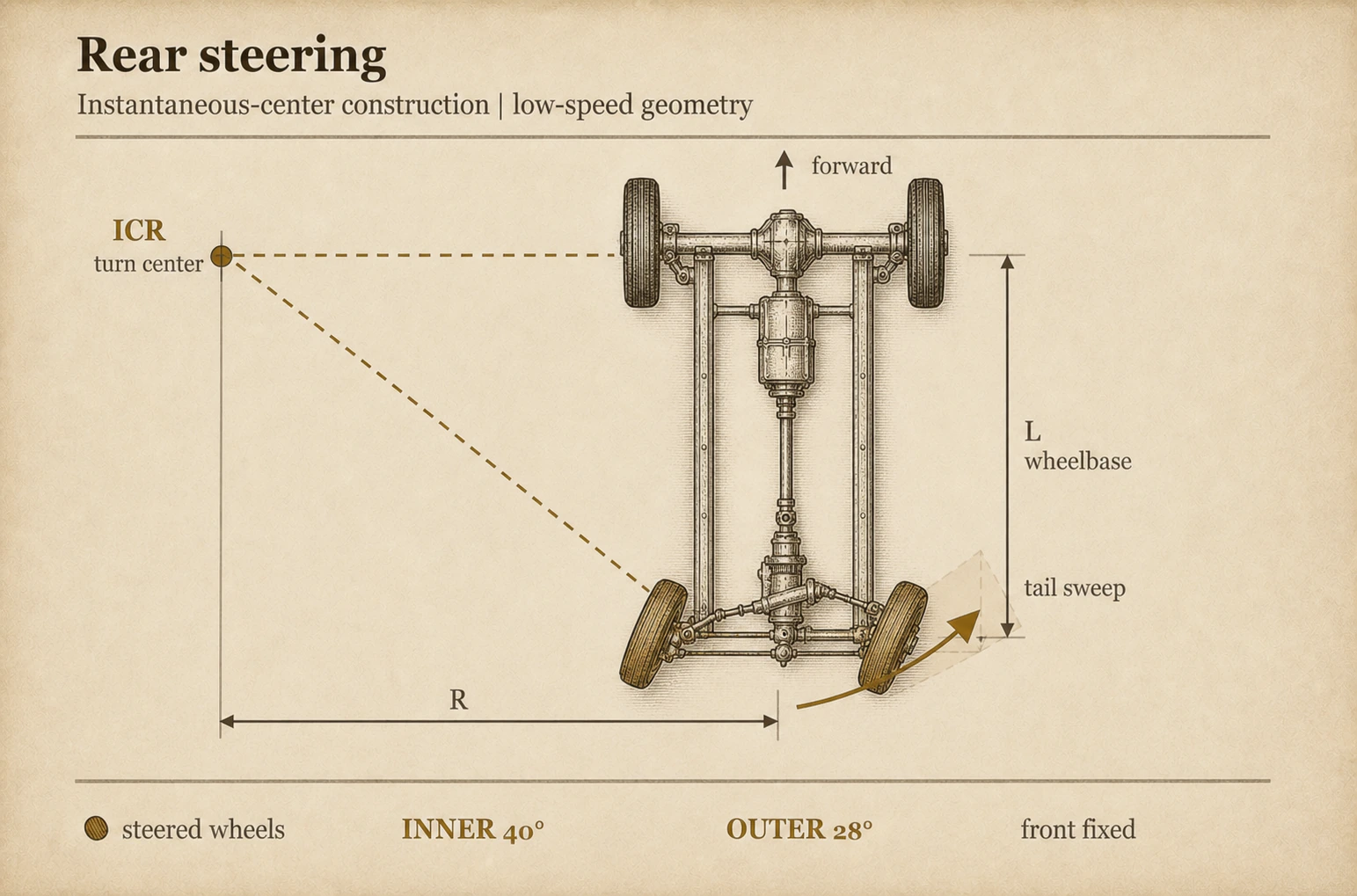
Figure 2. Rear-steering chassis: the ICR lies on the fixed front-axle line. The cutaway exposes the front drive axle, central transmission and driveshaft, and rear steering linkage that sends the tail initially to the right.
For the forklift, the front axle is unsteered. The body therefore turns about an ICR on the front-axle line. Every point behind that axle has an initial lateral velocity to the right: this is the tail swing, and it is why clearance is needed on the side opposite the turn. (The sedan has a smaller version of the same effect that the bicycle model hides: any point a distance behind the unsteered axle rides at radius and sweeps outward — the familiar overhang sweep of a bus. The forklift is extreme only in that its entire body sits behind the fixed axle.)
2. What “the same paths” means
Measure position at the midpoint of the unsteered axle. For either machine, the low-speed bicycle model can be written
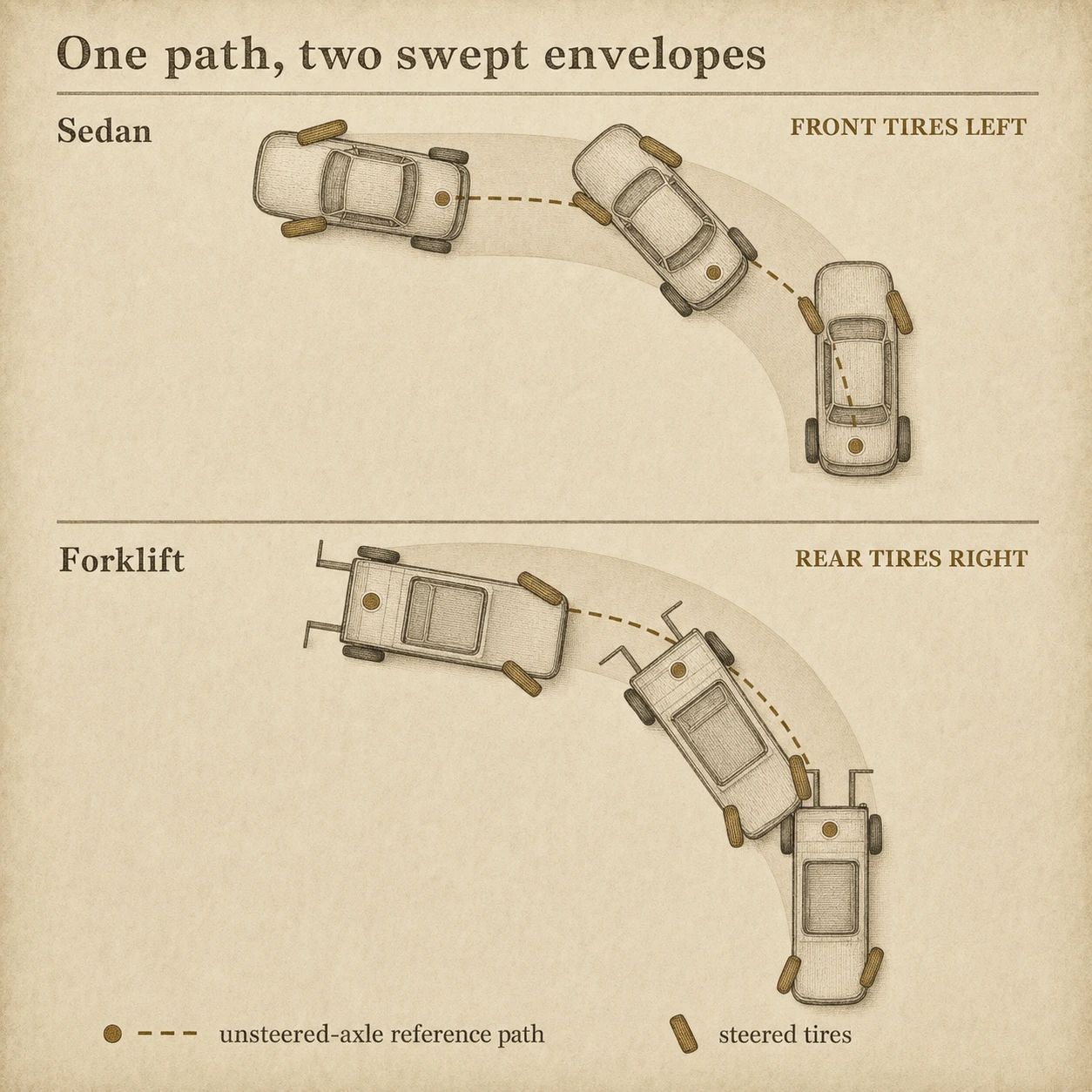
For the sedan that reference point is the rear axle. For the forklift it is the front axle, and the sign of the steering term flips — one line shows it: with the reference on the front axle, the rear axle sits at in body coordinates and moves at ; rolling without slip aligns that with the rear wheels’ heading, forcing . The minus sign is the answer to the second question: a left turn at forward speed demands rear wheels steered right. Since ranges over the same interval in both machines, the two systems are the same equations after : run both forward and their reference points trace exactly the same curves — that is Figure 3. There is also a second, coarser correspondence — turn the body plan through , so that the forklift’s steered rear axle stands where the sedan’s steered front axle stood — and that one exchanges forward with reverse; it is the dictionary behind the parking comparison below. They have the same minimum turning-radius magnitude,
and the same reachable body poses. The familiar reverse-and-countersteer sequence that produces a sideways parking displacement is available to both.
Figure 3. The dashed curve is the same unsteered-axle trajectory in both rows. Brass identifies the steered tires: front tires left for the sedan, rear tires right for the forklift. The body is attached to opposite sides of the reference point, so the same path does not produce the same swept envelope.
3. What is not the same
Reachability does not determine the swept envelope. In a fixed forward left turn, the sedan sends the body ahead of its rear axle to the left; the forklift sends the body behind its front axle initially to the right. Thus either machine can reach the same final pose, but it may need a different order of maneuvers and clearance on a different side.
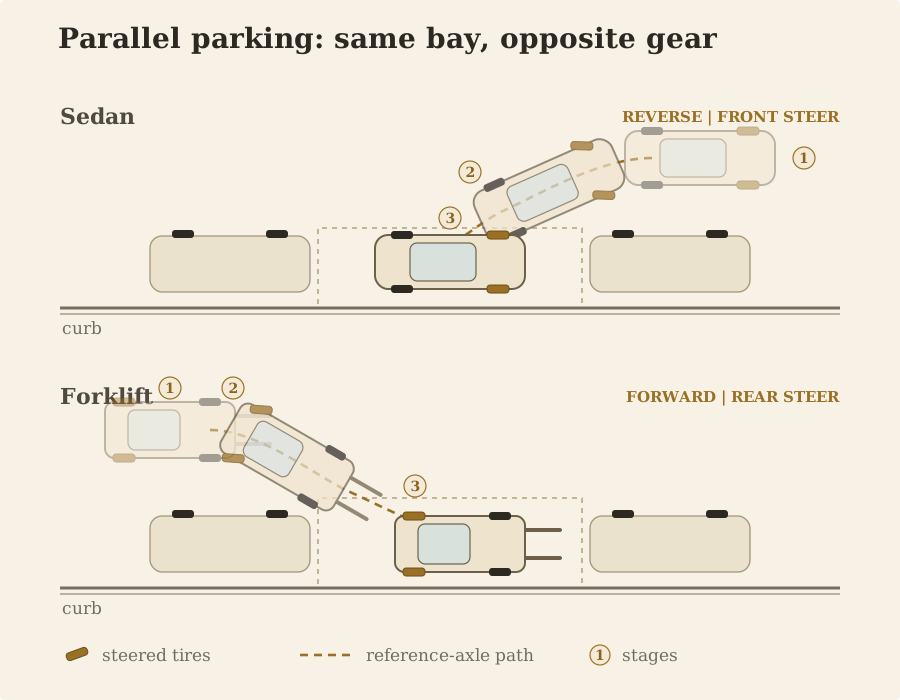
Parallel parking makes the distinction concrete. A front-steered sedan passes the bay and reverses its rear axle in, nose swinging out into the road before the countersteer. A rear-steered forklift makes the analogous placement moving forward — under the dictionary it simply is the reversing sedan: it approaches from behind the bay, its unsteered front axle carves in first, and its tail swings out into the road until the countersteer tucks it in. (A forward, tail-first entry is not available to it: swinging the tail toward the curb means yawing the nose away from it, and a forward run that ends parallel then nets displacement away from the curb — the tail dips in only to be pulled back out.) Both finish in the same pose, but the gear, the steered axle, and the side that needs clearance differ.
Figure 4. Same bay, opposite gear: the sedan backs in from ahead of the bay, the forklift drives in forward from behind it. In both machines the unsteered axle leads into the bay while the steered end sweeps the road. The numbered poses mark the stages, the dashed curve follows the reference axle, and the gold tires are the steered pair.
Compact answer: same reachable configurations; opposite initial body sweep. Sedan nose left, forklift tail right.
Deeper in the notebook: the Classical Mechanics shelf — still being bound; rolling constraints and the geometry of nonholonomy will live there.