The Earth is stopped dead on its orbit and begins to fall straight into the Sun. How long does the fall take? No integration is allowed — and the only number you may use is the length of the year.
Solution
About sixty-five days — the year divided by .
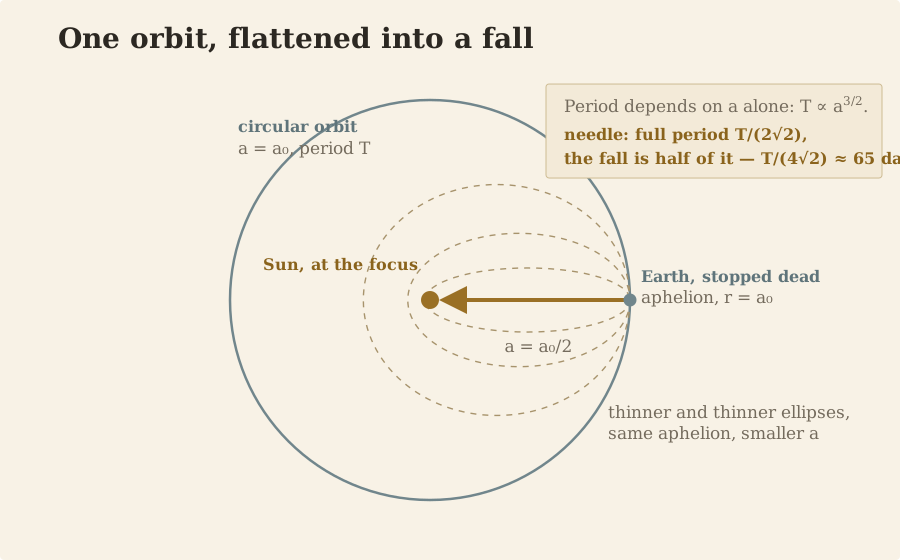
The straight fall is itself a Kepler orbit: the limit of ellipses stretched thinner and thinner around the Sun until the ellipse collapses onto a line. Falling from rest at the Earth’s distance means aphelion at and perihelion at the center — and because the Sun sits at a focus, the two turning distances always sum to the major axis, . Here that reads : the needle’s full length is its major axis, so . (The factor of two is where the whole answer lives.) Now use the one fact everyone knows: the period of a bound Kepler orbit depends on its semi-major axis alone, . The three-halves power is mechanical similarity in the potential — Problema XI’s law — while the indifference to eccentricity is the extra degeneracy of (one of Bertrand’s two closed-orbit power laws), the same one that closes its orbits. Together they let a circle of radius be compared with a needle of semi-major axis : the needle’s full period is , and the fall is the aphelion-to-perihelion half of it, days.
Figure 1. The construction, drawn to scale: every ellipse shares the Sun as focus and the Earth’s position as aphelion; as the eccentricity approaches one they collapse onto the needle, whose semi-major axis is half the circle’s. Period follows alone, so the needle completes its circuit in — and the fall is its outbound half.
Mechanics: Landau & Lifshitz, Mechanics, §10, “Mechanical similarity,” derives the scaling law, while §15 treats the Kepler problem itself. Arnold, Mathematical Methods of Classical Mechanics, 2nd ed., §11, “The method of similarity,” and §8 E, “Kepler’s problem,” give the geometric companion.
The two natural worries dissolve on inspection. That the orbit runs into the point where the force law diverges costs nothing: the plunge is fastest exactly where the geometry is worst, and striking the Sun’s actual surface rather than its center trims only about twelve minutes off the answer — at the photosphere the Earth would already be moving at very nearly the solar escape speed, some (short of it by the factor , a fifth of a percent: bound orbits never quite reach it). And nothing about the Earth itself entered: any object halted at — a planet, a pebble, a stalled comet — takes the same sixty-five days to arrive. The honest error bar comes from elsewhere: only the year was allowed, so means the semi-major axis, and the real Earth’s distance wanders by around it — stop the planet at perihelion or aphelion and the answer moves between 63 and 66 days, a spread a hundred times the solar-radius correction.
Astrophysicists carry this answer around as the free-fall time: stop anything at radius from a mass and it reaches the center in of the circular period at . Written with the mean density inside it becomes — the form quoted in every star-formation paper, and it carries over from a point mass to a uniform cloud because no shell overtakes another: each falls under the fixed mass it encloses, and all arrive together. It is the natural clock of gravitational collapse, from star formation to the emptying of a galactic nucleus.
Papers: McKee & Ostriker, Theory of Star Formation (2007) gives the broad collapse framework; Krumholz & Tan, Slow Star Formation in Dense Gas (2006) measures star formation explicitly per free-fall time. For the galactic-nucleus end of the scale, Hopkins & Quataert, An Analytic Model of Angular Momentum Transport by Gravitational Torques (2011) is the realistic complement to the ideal plunge: gas must shed angular momentum through torques and shocks before it can flow inward.
Deeper in the notebook: 02. Geodesics, Orbits, the Effective Potential · the Classical Mechanics shelf, where the Kepler problem will live.