Einstein’s elevator: sealed in a freely falling lab, you are supposed to be unable to distinguish it from a lab floating in deep space. You have two marbles and as much patience as you like. Can you nevertheless prove there is a planet outside?
Solution
Yes — the equivalence principle is local, and two marbles are enough to probe “non-local.”
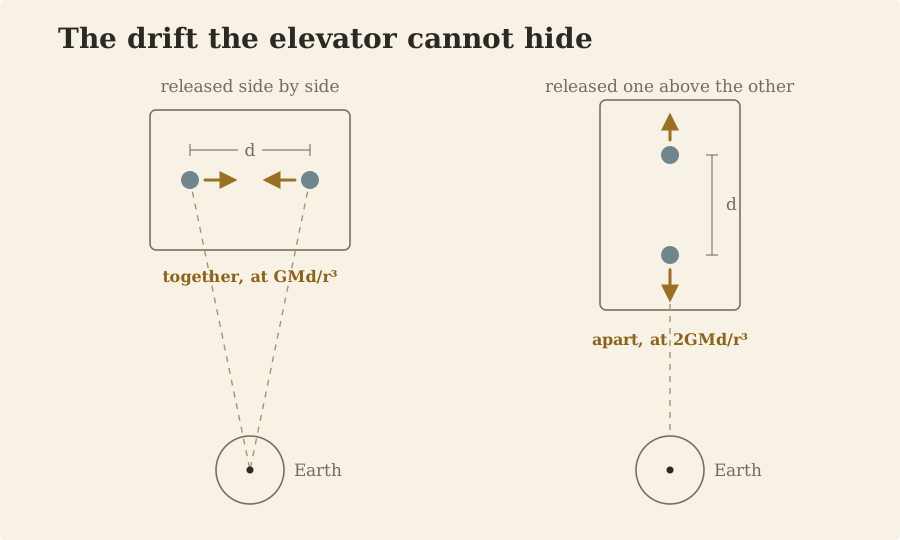
Release the marbles a horizontal distance apart: each falls toward the center of the Earth, so their paths converge, and they drift together at tidal acceleration . Release them one above the other instead: the lower one sits in a stronger field and pulls ahead, so they separate at . A lab in empty space shows neither.
Figure 1. The residue. Side-by-side marbles converge because “down” is not one direction; stacked marbles separate because the field is not one strength. The factor two between the rates is Laplace’s equation in disguise.
That is why you were given patience: for marbles a couple of meters apart the tidal acceleration is only , microns of drift in the first second. But it compounds — the stacked pair separates exponentially with e-folding time minutes, and the side-by-side pair oscillates with period minutes, which is no coincidence: it is the orbital period at Earth-surface radius. Wait a quarter of an hour and the residue is no longer subtle. Squeeze in the horizontal plane, stretch along the vertical — and the pattern is rigid: the eigenvalues are , summing to zero because in vacuum. One stretch is paid for by two squeezes, and the traceless signature is also the alibi against fakes — a slowly spinning lab in deep space pushes marbles apart too, but outward in two directions and not at all along the spin axis, a pattern with nonzero trace (and one your gyroscope would have flagged anyway). That residue is what no choice of freely falling frame can erase.
The formal statement: coordinates can flatten the metric and kill its first derivatives at a point (that is the freely falling frame), but the second derivatives cannot all be removed — twenty independent combinations survive every coordinate choice, and those twenty are the Riemann tensor. Gravity’s irreducible signature is not the pull, which you can transform away, but the squeeze, which you cannot. Relative acceleration of nearby free-fallers is geodesic deviation, and it is the curvature tensor read off with rulers and marbles.
Deeper in the notebook: 01. Tidal Forces and Geodesic Deviation · 02. Weak, Einstein, and Strong Equivalence Principles · 01. Jacobi Fields